With Custom Prompts you define the text that ThunderAI sends to the AI service, together with the email you are reading or writing. Your prompts appear in the ThunderAI menus next to the built-in ones.
Open the Manage Prompts page with the 
 button in the add-on options.
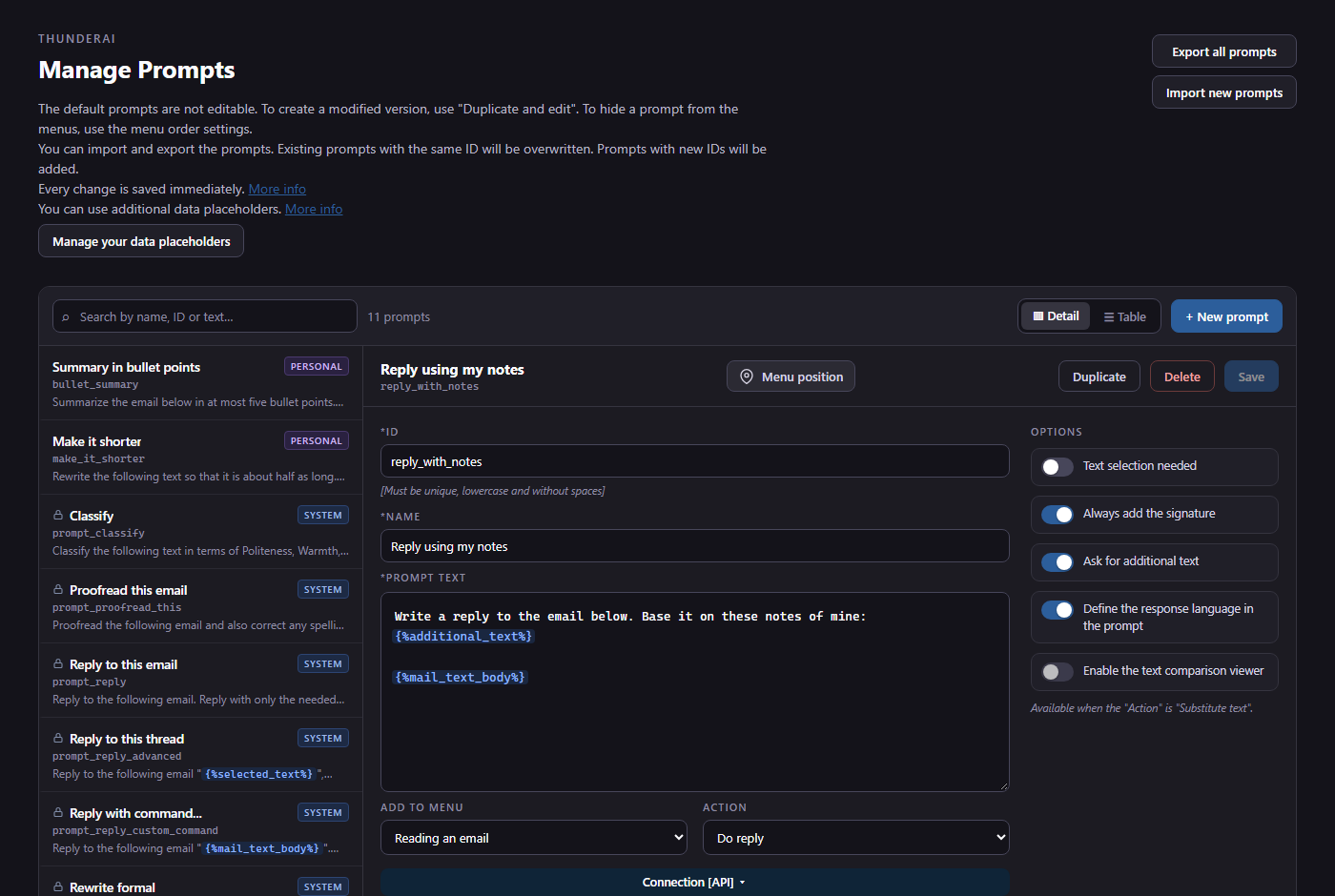
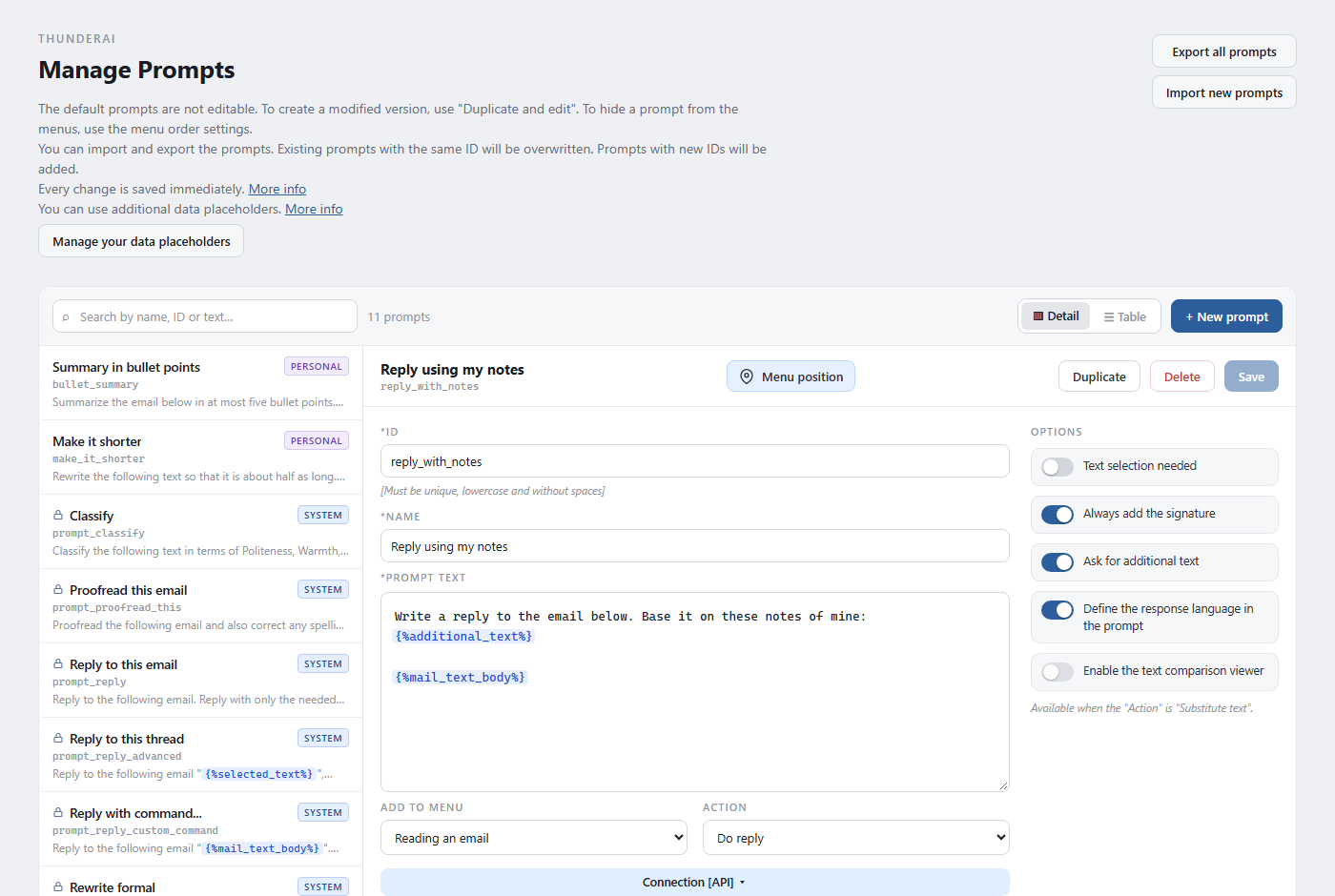
The page
The page shows all your prompts and the built-in ones in a single list. Next to the name, each prompt has a badge:
- Personal: a prompt you created. You can change it or delete it.
- System: a built-in prompt. It is read-only and is marked with a padlock.
- Organization: a prompt set by your organization's configuration (see below). It is read-only.
The search box filters the list by name, ID or prompt text.
The list has two views, and you switch between them with the 
 and

 buttons:
- Detail: the list is on the left, and the selected prompt opens on the right, where you can change it.
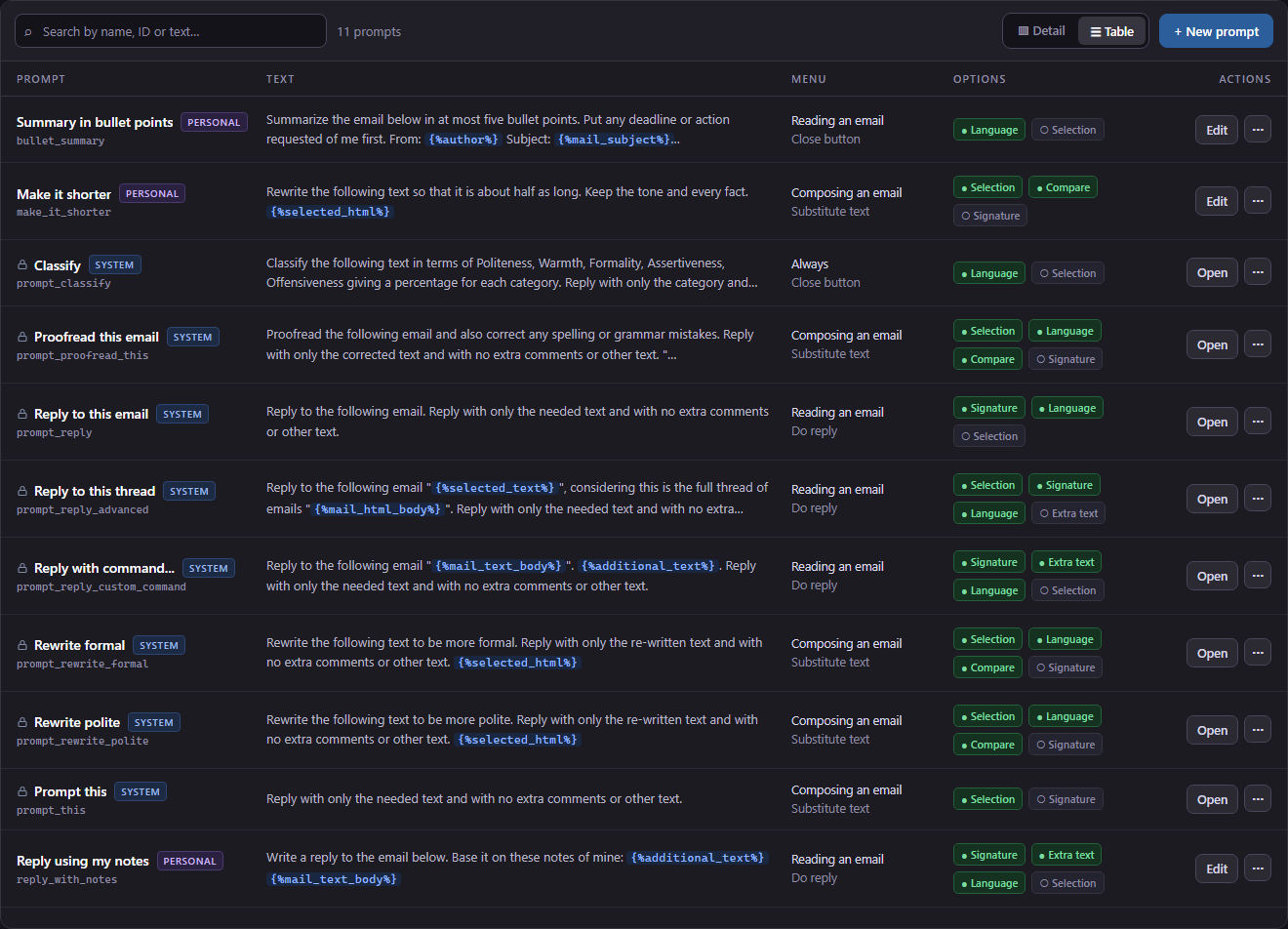
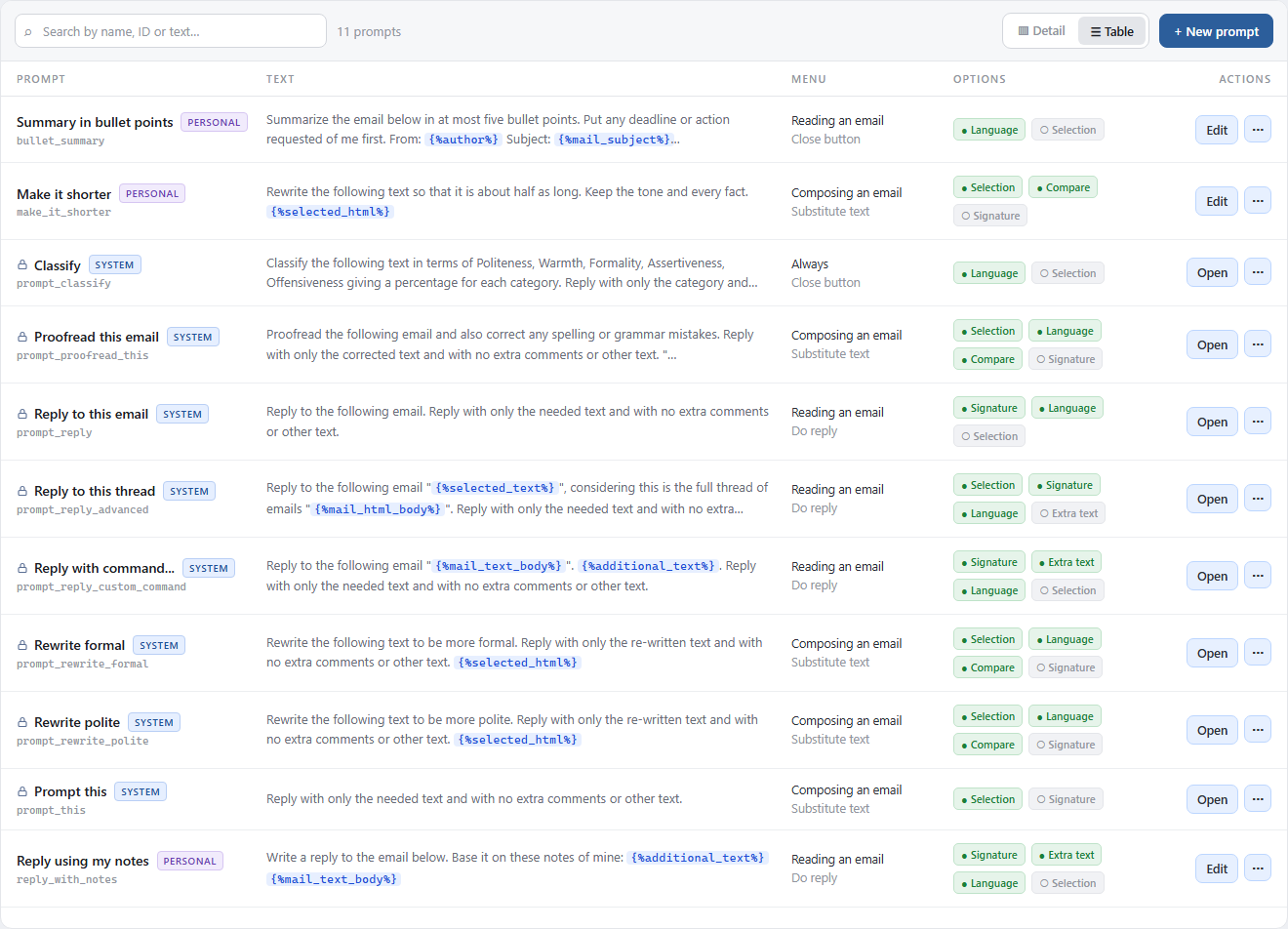
- Table: one row per prompt, with its text, the menu it is in, the action and its options. Click

 (or

 on a read-only prompt) to open it in the Detail view. The

 button gives more actions: Duplicate, Export and Delete.
Every change is saved immediately. There is no "Save all" button. When you click 
 on a prompt, or delete or import prompts, the change is stored and the menus are updated at once.
If you leave a prompt with changes you have not saved, ThunderAI asks whether to apply them or discard them.
Creating a prompt
Click 
 , fill in the fields, then click .
- ID: the unique identifier of the prompt. It must be lowercase, with no spaces. While the field is empty, ThunderAI builds the ID from the name as you type it.
- Name: the text shown in the menus. It cannot contain the
%character. - Prompt Text: the text sent to the AI service. You can use the data placeholders here: type
{%to get the list of the available ones. A known placeholder is highlighted. An unknown one is shown in red, and one that does not work with the menu you chose (for example a compose-only placeholder in a prompt shown when reading) is shown in amber. - Add to menu: when the prompt is shown:
- Always: when reading and when composing an email.
- Reading an email: only when reading.
- Composing an email: only when composing.
- Action: what happens with the answer of the AI service:
- Close button: the answer is only shown, and the AI chat window can be closed.
- Do reply: a new compose window opens, replying to the selected message with the answer (as the built-in "Reply to this email" prompt does).
- Substitute text: the answer replaces the original text in the email you are writing.
Options
Five switches change how the prompt works:
- Text selection needed: the prompt works only on the selected text.
- Always add the signature: the signature defined in the options is always added.
- Ask for additional text: after the AI chat window opens, ThunderAI asks for some text, which is added to the prompt. Use it with the
{%additional_text%}placeholder. - Define the response language in the prompt: a statement with the default language, set in the add-on options, is added to the prompt. If no default language is set, the statement is "Reply in the same language".
- Enable the text comparison viewer: it adds a button to the AI chat window that shows the differences between the original text and the one proposed by the AI. It is useful for "rewrite" prompts. It is available only when the Action is Substitute text.
If the prompt text uses {%additional_text%}, {%selected_text%} or {%selected_html%} but the matching switch is off, the switch is highlighted.
A connection for each prompt
By default, a prompt uses the connection set in the add-on options. Open the Connection [API] section to choose a different AI service, model or server for one prompt only. 
 clears these settings: after you click , the prompt goes back to the global connection.
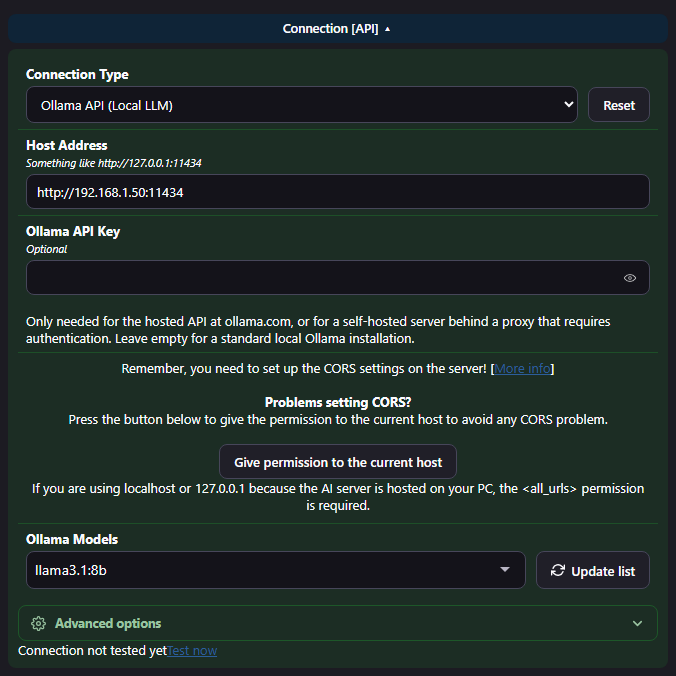
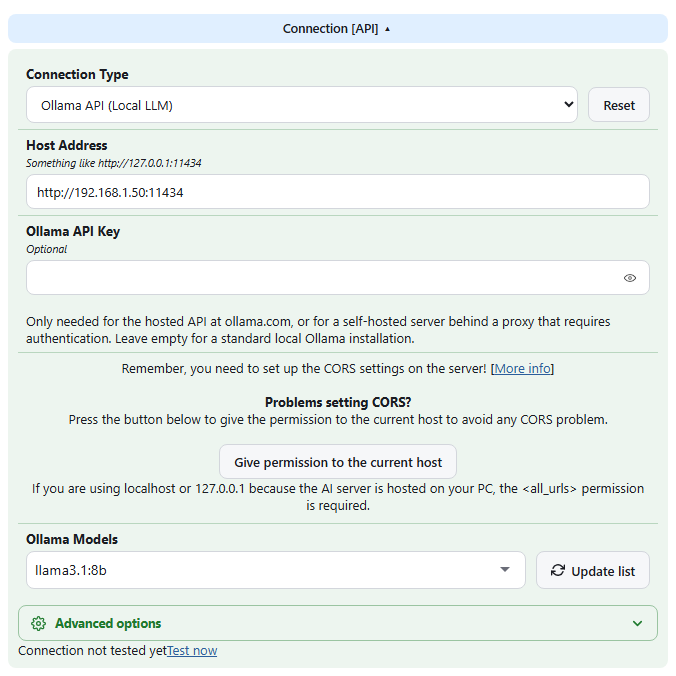
When the global connection is ChatGPT Web and the prompt has no connection of its own, a ChatGPT Web section lets you choose a model, a project or a custom GPT for this prompt.
Built-in prompts
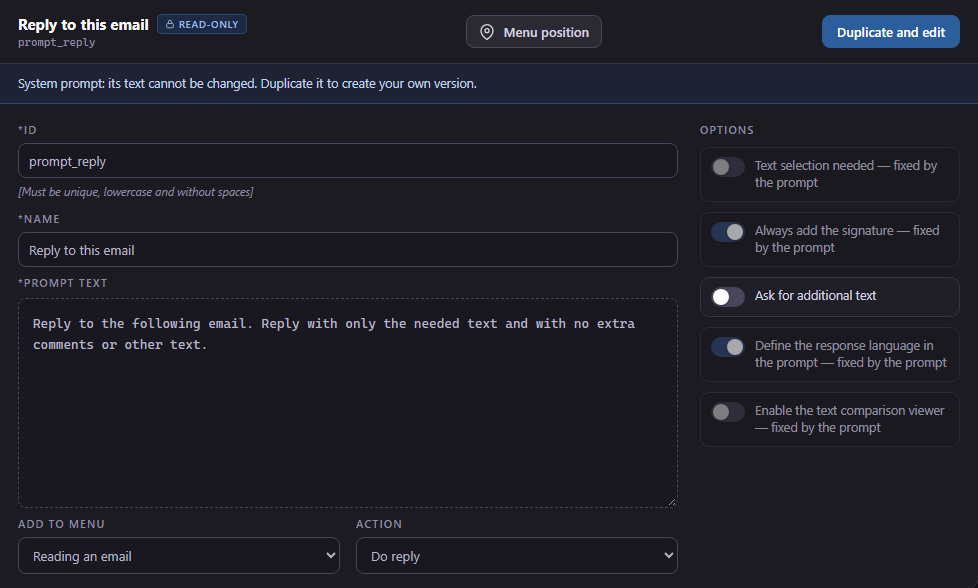
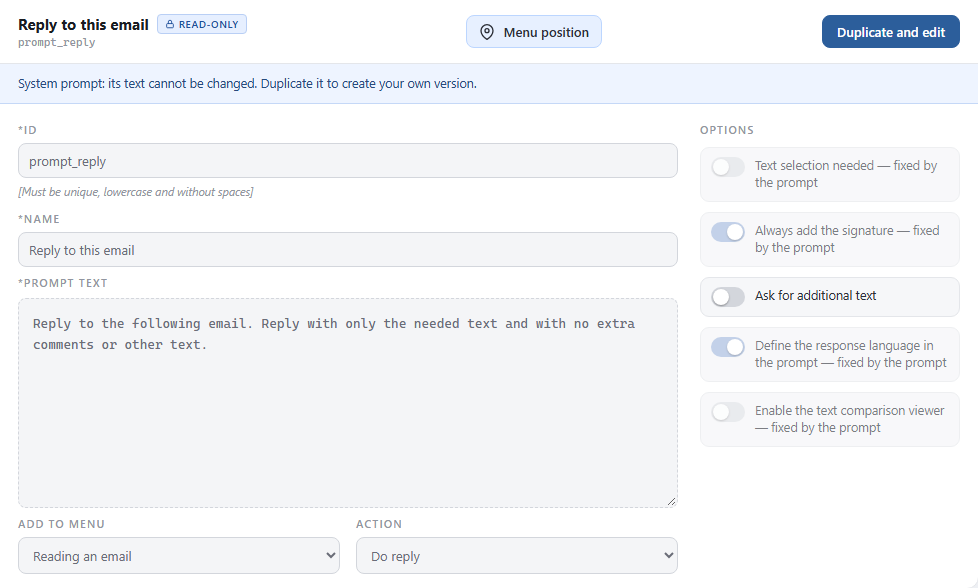
The built-in (System) prompts cannot be changed. The only option you can change is Ask for additional text. The other options are marked "fixed by the prompt".
To make your own version of a built-in prompt, click 
 . The copy is a new personal prompt, with the same text and options, that you can change freely.
Showing, hiding and ordering the prompts
This page defines what a prompt does. Where it appears is set on the Menu Order page, opened with the 
 button in the add-on options: there you can reorder the prompts in the menus, and hide a prompt (built-in ones too) by dragging it into the "Hidden items" section.
The 
 button at the top of a prompt opens the Menu Order page and highlights that prompt.
Other actions

 : creates a copy of a personal prompt.

 : deletes a personal prompt, after a confirmation.
 : saves all the prompts to a file. ThunderAI asks whether to include the connection settings: if you include them, the file also contains the API keys. You can also export a single prompt from the menu in the Table view.
 : loads prompts from an exported file. Prompts with an ID already in the list are overwritten, and prompts with a new ID are added. The imported prompts are saved immediately, so ThunderAI asks for a confirmation first.

 : opens the page where you define your own data placeholders.
Prompts managed by your organization
If your organization configures ThunderAI with a policy, the page can show some differences:
- Organization prompts are read-only. If one has the same ID as one of your prompts, yours is kept but disabled, and it works again if the organization prompt is removed.
- If prompt management is disabled, you cannot create, duplicate, import or export prompts, and your own prompts are read-only and are not shown in the menus. They are not deleted.
- If the built-in prompts are disabled, they are still listed here, but they are not shown in the menus.
Administrators can find the details in the Enterprise Configuration Guide.